Tea has paired them for centuries. Here is how L-theanine and caffeine differ, what the research really shows and where each sits in our blends.
Coffee wakes you up, a cup of tea feels a little smoother, and somewhere between the two sits one of the most talked-about pairings in the supplement world: L-theanine and caffeine. The quick answer to how they differ? Caffeine is a stimulant. L-theanine is an amino acid from tea leaves that isn’t a stimulant at all, and researchers have spent almost two decades testing what happens when the two arrive together, just as they do in your teacup.
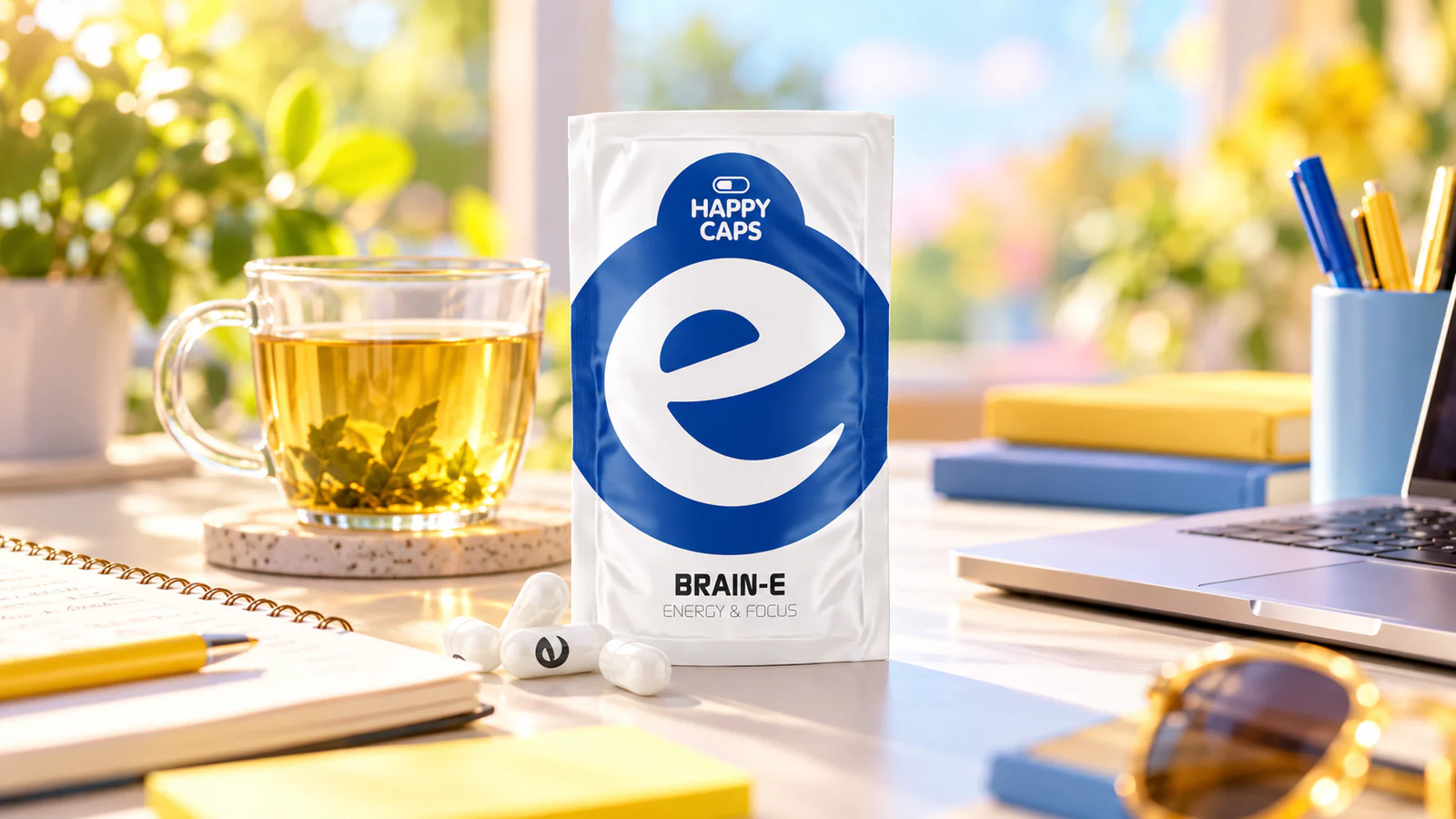
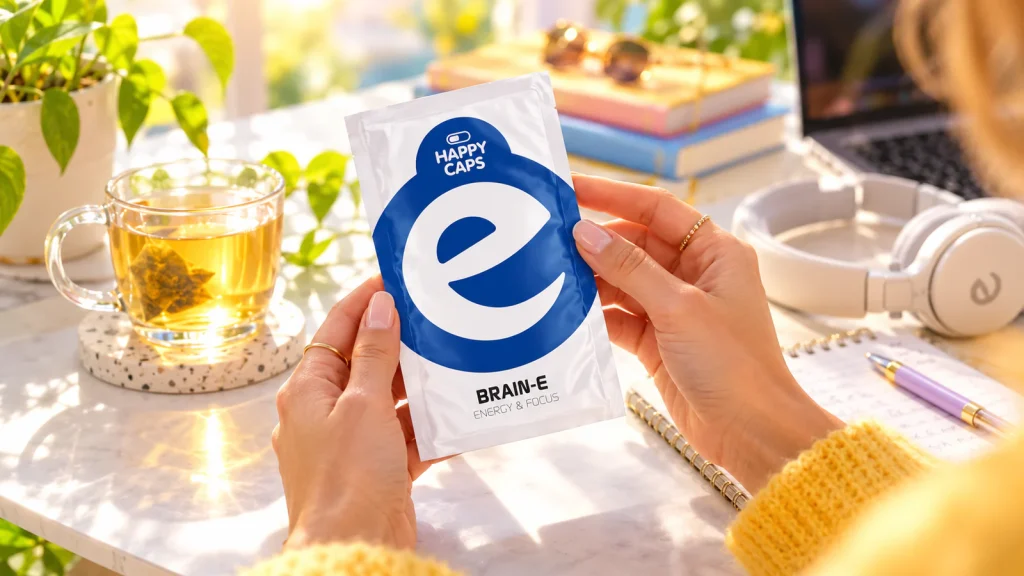
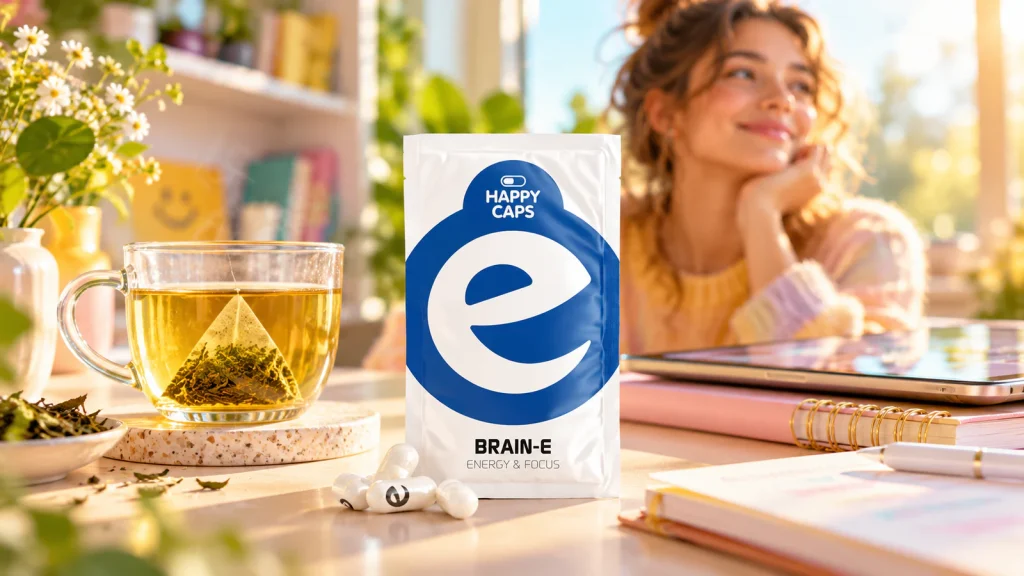
Au Happy Caps we’ve been creating blends in the Netherlands since 1997, and our capsules are organised by mood rather than by single ingredients. Both ingredients feature in our range, just not in the same way: Brain-E lists L-theanine and caffeine side by side, while Energy-E lists caffeine-rich guarana extract and no L-theanine at all.
So here’s the friendly version: what each ingredient is, what the studies actually found, and how to choose the blend that fits your day.
L-theanine vs caffeine: two very different ingredients
caféine is the world’s most widely consumed stimulant, found in coffee beans, tea leaves, cocoa and guarana. It works mainly by blocking adenosine, a messenger molecule that builds up during the day and signals tiredness. That’s why caffeine is so closely linked with feeling alert, and also why a late espresso can keep you staring at the ceiling.
L-théanine is an amino acid found almost exclusively in the tea plant, Camellia sinensis. Green and black tea both contain it; coffee doesn’t. It isn’t a stimulant, and on its own it has shown fewer clear effects in studies than its reputation suggests. Most of the scientific interest comes from how it behaves next to caffeine.
L-théanine
caféine
Ce que c'est
An amino acid
A stimulant
Main natural sources
Tea leaves
Coffee, tea, cocoa, guarana
In a cup of coffee
Non
Oui
In a cup of tea
Oui
Oui
Listed in Brain-E
Oui
Oui
Listed in Energy-E
Non
Yes, via guarana extract
Cocoa also carries a close relative of caffeine called theobromine, and we compare the two in théobromine vs caféine.
What research says about L-theanine and caffeine together
Tea delivers both ingredients naturally, which is what first drew scientists to the pairing. Most studies follow the same design: healthy adults take caffeine, L-theanine, both or a placebo on separate days, then complete computer-based attention and memory tasks.
The classic study: in a 2008 trial with 27 volunteers, 50 mg of caffeine combined with 100 mg of L-theanine improved speed and accuracy on an attention-switching task and reduced distraction during a memory task, compared with a placebo.
Higher amounts: another 2008 trial, using 150 mg of caffeine and 250 mg of L-theanine, found the combination improved several reaction-time and accuracy measures, and participants rated themselves more alert and less tired.
The bigger picture: a 2014 meta-analysis of 11 placebo-controlled studies found moderate effects in favour of the combination on self-rated alertness and attention-switching accuracy in the first two hours, with the caffeine dose appearing to matter more than the L-theanine dose.
The counterpoint: a 2015 study using tea-like amounts (75 mg of caffeine, 50 mg of L-theanine) found that adding L-theanine wiped out caffeine’s measurable effects on attention and mood, without bringing any benefit of its own.
The honest summary: the pairing is well studied and the results are interesting, but they come from small groups, single doses, short lab sessions and specific amounts. They’re research observations, not promises about how any capsule will feel, ours included.
Where each ingredient shows up in Happy Caps blends
Brain-E is the blend in our range that lists both. Its ingredient list names L-theanine and caffeine alongside rhodiola rosea, choline, GABA, L-carnitine, L-tryptophan, nicotinamide, L-arginine and black pepper extract. The caffeine is easy to overlook, because the product description highlights rhodiola, choline and L-theanine, so the full ingredient list is the place to look.
Energy-E takes a different route. It lists guarana extract (30% caffeine) together with rhodiola rosea, beta-alanine and L-arginine, and it contains no L-theanine. If you’ve ever wondered about the pins-and-needles feeling some energy formulas bring, our guide to beta-alanine tingling explains where it comes from.
One thing to keep in mind: neither product page gives an amount per capsule for individual ingredients, so you can’t match a capsule one-to-one with the amounts used in the studies above. A blend of ten ingredients is a different thing from a two-ingredient lab test.
Brain-E or Energy-E: which blend fits your day?
Neither blend is the “better” one. They’re built for different kinds of days, and the product pages say so in their own words. Brain-E is designed to match your mental pace, for days filled with ideas, learning or deep digital flow. Energy-E is created for long nights, active days and everything in between, whether that’s a workout, a night out or a demanding shift.
Brain-E
Energy-E
L-théanine
Oui
Non
caféine
Oui
Via guarana extract (30% caffeine)
Other ingredients you’ll spot
Rhodiola, choline, GABA
Rhodiola, beta-alanine, L-arginine
Designed for
Study, work, problem-solving and gaming sessions
Active days, workouts, nights out and long shifts
Pack
4 capsules
4 capsules
Both blends are intended for healthy adults aged 18 and over, and both product pages advise against use during pregnancy or breastfeeding. Weighing up Game-E as well? Our Brain-E vs Energy-E vs Game-E comparison puts all three side by side.
How to read a label that lists both ingredients
A few quick checks tell you far more than a front-of-pack promise:
Find every caffeine source. Caffeine can appear by name or hide inside guarana, green tea or yerba mate extracts.
Look for amounts. A study result only means something next to an amount per capsule. No amount, no fair comparison.
Check what else is in the mix. In a multi-ingredient blend, the other ingredients shape the formula just as much. Our guide to ce que contient un mélange Happy Caps shows how we put ours together.
Count your whole day. Capsules, coffee, tea, cola and energy drinks all add to the same caffeine total.
Read the warnings and the directions. Follow the instructions on the packaging rather than a dose from a study.
Where to start in the Happy Caps range
If the tea-inspired pairing is what caught your eye, Brain-E is the blend to look at first. If your plans are more about moving, from training to dancing to a long shift, Energy-E builds on guarana instead. Both come in handy four-capsule packs, so they slip easily into a bag or a desk drawer.
It’s a popular idea, but the evidence is mixed. One 2008 study found people rated themselves less tired and more alert on the combination than on placebo, while a 2015 study found L-theanine simply wiped out caffeine’s measurable effects. Few studies have measured jitteriness directly, so there’s no solid basis for promising a smoother feel.
Does coffee contain L-theanine?
No. L-theanine comes almost entirely from the tea plant, which is why green and black tea naturally contain both ingredients while coffee provides caffeine alone.
Which Happy Caps blend contains both L-theanine and caffeine?
Brain-E. Its ingredient list includes L-theanine and caffeine along with rhodiola, choline and GABA. Energy-E contains caffeine via guarana extract but no L-theanine.
How much caffeine is too much in a day?
For healthy adults, the European Food Safety Authority considers up to 400 mg a day, and single amounts up to 200 mg, to raise no safety concerns. During pregnancy the reference point is 200 mg a day. Remember to count every source, not just one product.


 100% conforme aux ingrédients


 Français
 English
 Nederlands
 Deutsch
 Español
 Italiano