How to Choose a Supplement Supplier: A Retailer’s Buying Checklist
A practical checklist for choosing a supplement supplier: what to check on documentation, labels, consistency, availability and support before you order.
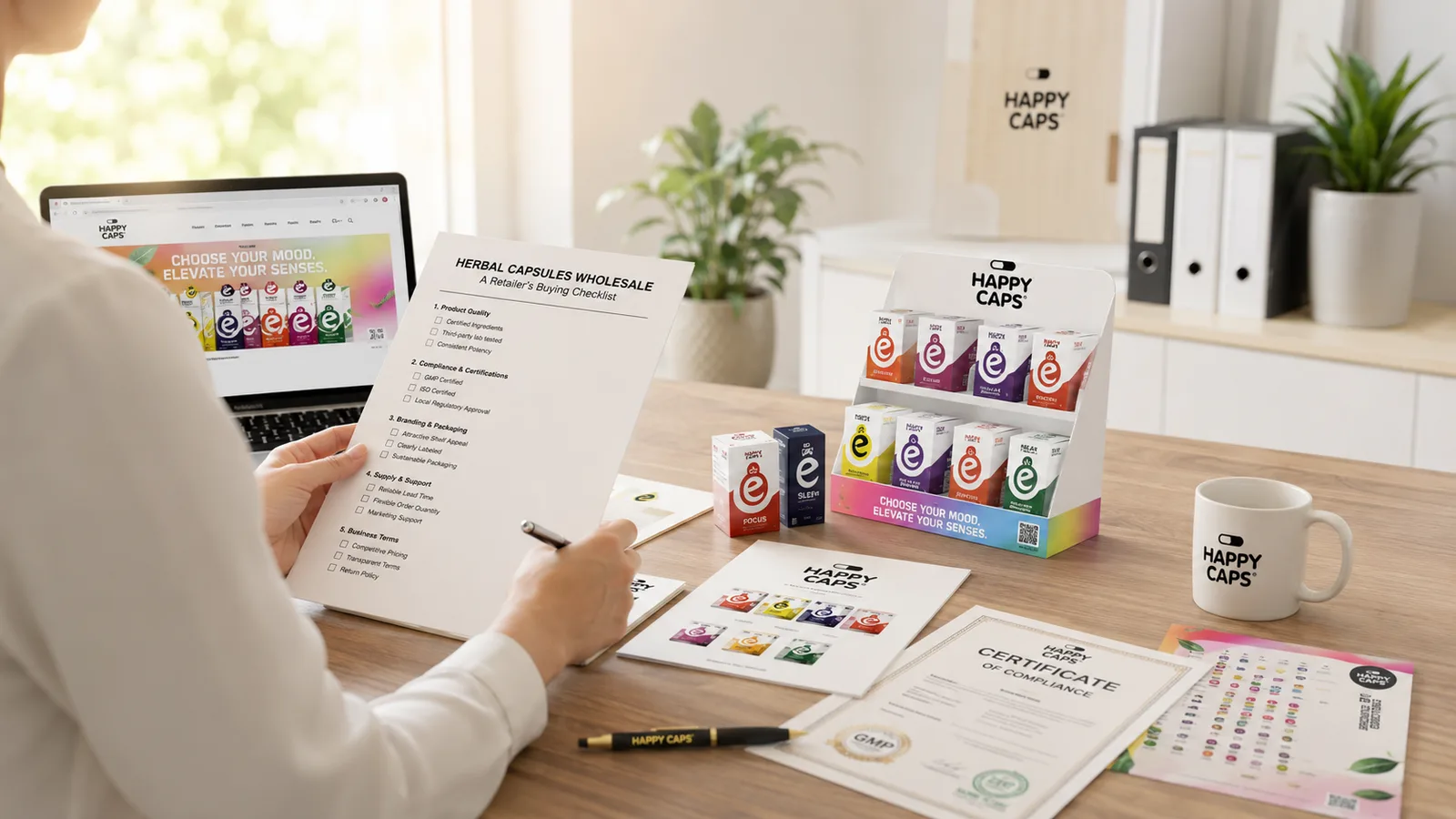
Choosing where to source your stock is one of the most important decisions a retailer makes, and it rarely comes down to the price per unit alone. Working out how to choose a supplement supplier means looking past the headline price to what actually shapes your customers’ experience: the consistency of what lands on your shelf, the clarity of the labels, the paperwork you can show when someone has a question, and how easily you can reorder a bestseller.
A cheaper case of stock becomes an expensive problem when quality drifts between batches, labels miss information your market expects, or a popular line disappears for weeks. The right partner makes it easier to sell with confidence — whether you are sourcing herbal capsules wholesale, sprays, or a broader supplement range.
This is a practical buying checklist for retailers, distributors, smart shops, concept stores and ecommerce businesses still comparing suppliers. Work through the criteria below before you send that first enquiry — they help you tell a genuine long-term partner apart from a one-off bargain.
What Should Retailers Look for in a Supplement Supplier?
I rivenditori dovrebbero cercare un supplement supplier that can show a verifiable business identity, clear and compliant labels, accessible documentation, consistent quality between orders, reliable availability, transparent wholesale terms, and responsive support before and after the first order. The best supplier is the one that lets you sell and restock with confidence, not just the one with the lowest headline price.
The sections below turn each of those points into questions you can put to a supplier.
1. Verify the Supplier’s Business Information
Before any product conversation, confirm who you would actually be trading with. Check that you can verify the registered company name, a real business address, the country the business ships from, and a direct contact — phone, email or a named person — rather than only a generic enquiry form. Ask who handles your account once you become a customer, and how to reach them.
Requirements for business documentation differ between countries, and this is not a substitute for your own legal or tax checks — treat it as a first, practical filter. A supplier that is vague about its own identity, or hard to reach outside a sales enquiry, is worth a second look before a first order.
2. Review Product Documentation and Traceability
Good documentation lets you evaluate a product properly, brief your team and answer customer questions without guessing. Depending on the product, the material a retailer may be able to request includes:
Product specifications and ingredient information.
Informazioni di lotto o tracciabilità, ove applicabile.
Analisi pertinenti o documenti a supporto.
Immagini di prodotto e descrizioni commerciali.
Usage, warning and any available regulatory information.
Traceability matters beyond paperwork for its own sake: if a batch needs to be queried or withdrawn, a supplier that can trace it quickly limits the disruption to your shelf. Not every document is mandatory in every case, and the paperwork tied to a food supplement in the EU can differ from one product to the next — the panoramica della Commissione europea sugli integratori alimentari is a useful reference. The practical step is simple: ask what documentation is available before placing a first wholesale order.
Una guida di approfondimento sulla documentazione di prodotto for retailers works through these files one by one, including what a label has to carry and what a lab report actually tells you.
3. Check Labels and Product Information
A clear label helps your team answer questions and keeps your listings accurate online. Before you commit, check that each product carries a clear product name, ingredients, content or format, a batch identifier and relevant date, instructions for use, any warnings, and the languages your market needs.
It is also worth checking that the packaging, the product sheet and the online description all say the same thing — mismatches create returns and awkward conversations. Labelling obligations in the EU are set out in the norme UE sull'informazione alimentare, and the exact requirements can depend on the product and market. Treat this checklist as a commercial starting point, not legal advice, and confirm your own obligations for each country you serve.
4. Evaluate Product Consistency and Quality Controls
Quality is what your customers judge you on, even though they bought from you, not your supplier. If a product feels different from one order to the next, it is your shelf that looks unreliable. A good supplier keeps the product, composition and presentation stable between orders, and tells you in advance when something changes rather than letting you discover it at unboxing.
Ask directly how the supplier manages quality and how it would let you know if something were updated. Where a sample is available, use it to check presentation and labelling — but treat it as a starting point, not proof of ongoing consistency; that only becomes clear once you compare a few repeat orders.
5. Check Availability and Wholesale Terms
A long catalogue is not the same as reliable availability, and unit price is easy to compare — which is exactly why it can be misleading. Before you decide, get a feel for typical preparation and dispatch times, how often stock is replenished and shortages communicated, minimum order requirements, how flexible the product mix is, payment and shipping terms, how returns are handled, and any market restrictions.
Knowing the lead time before you launch a campaign is not a detail — it is the difference between a smooth launch and an empty shelf. A slightly higher unit price can be the better deal once flexible ordering and a clear returns process are factored in.
6. Check Shelf Life, Storage and Stock Rotation Information
Before you order, it is worth knowing how much shelf life you are actually buying, not just what is in the box — the storage conditions a product needs, what date or batch information appears on the packaging, and how much time that leaves once stock reaches your shelf.
7. Check Whether the Product Range Fits Your Store
The right supplier is not an absolute — it depends on your store. Before comparing prices, check whether the range fits the customers you serve: your store type, the categories and formats you already carry, your customers’ price range, whether products are clearly differentiated or likely to overlap, and how easily you can explain each one without a long briefing.
Our guide to pianificazione della gamma per smartshop works through building a range around customer need, format and category — useful groundwork before adding a new supplier’s catalogue to what you already stock.
8. Review Retail and Merchandising Support
Retail-ready presentation means each product is easy to identify, visually distinct, and formatted for display rather than just shipping. It is worth checking whether a supplier can also provide staff-facing product information, images for a catalogue or webshop, and anything that helps you present a range by category in store.
Our guide to supplement merchandising for smartshops covers planning displays, signage and point-of-sale materials once a range is on your shelf. Do not overlook the basics either: packaging should protect the product during transport so it reaches your customer in the condition you paid for.
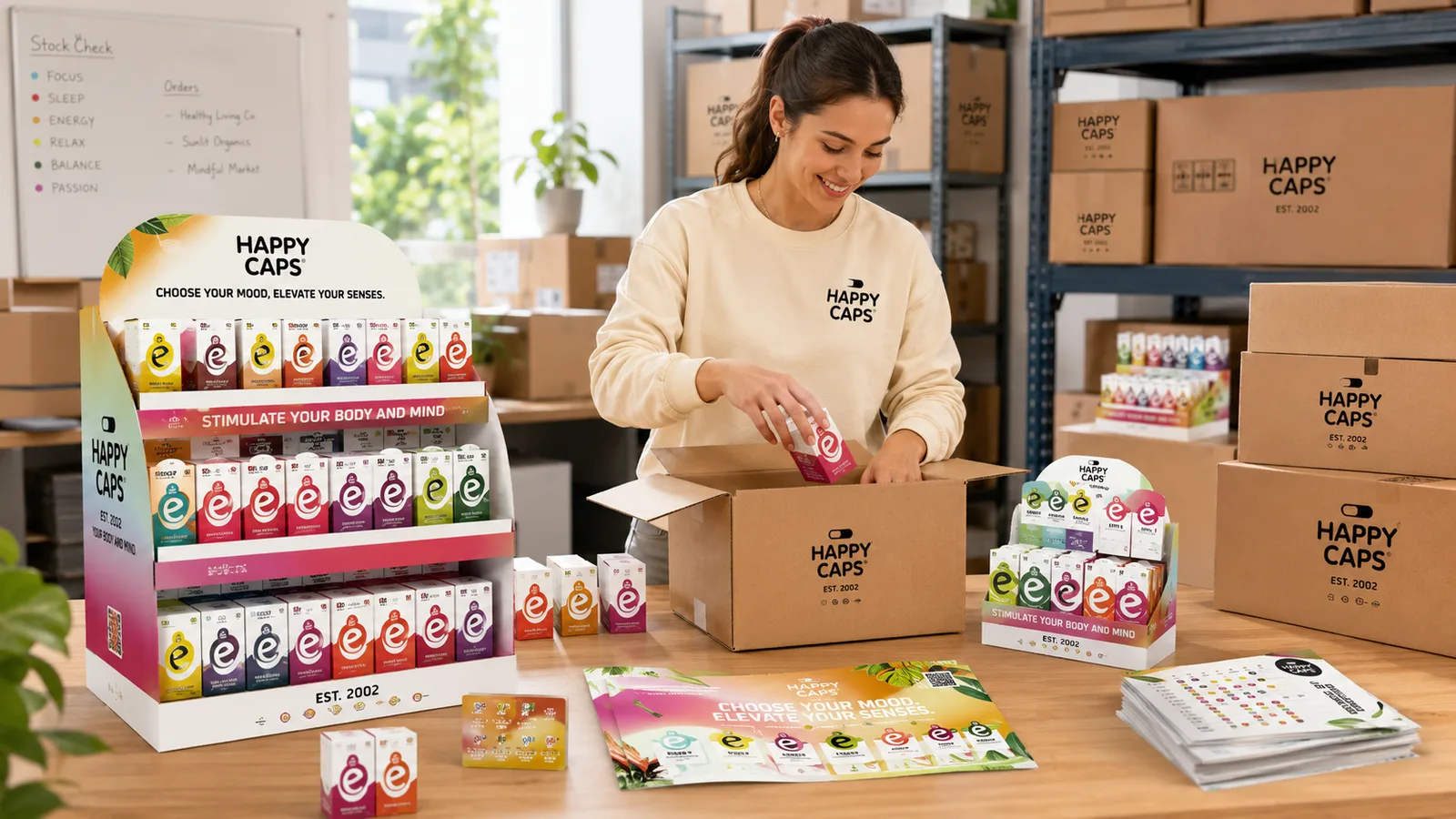
Scorte affidabili, confezioni riconoscibili ed espositori pronti per lo scaffale rendono una gamma più facile da lanciare e riassortire.
9. Evaluate Communication and Reordering
The first order is the start of the relationship, not the end of it. Strong support shows up as clear commercial answers and a contact you can actually reach once you are a customer, not just before you sign up.
After that first delivery, the useful signals are practical: does the supplier confirm orders clearly, tell you about shortages or product changes before you find out the hard way, and resolve a discrepancy without a long back-and-forth? Understanding how the supplier expects reorders to work makes ongoing supply far more predictable than treating every repeat order as a fresh negotiation.
Red Flags When Choosing a Supplement Supplier
A few signals are worth treating as a pause-and-check moment rather than a detail to overlook:
Business information that is hard to verify, or a supplier that avoids direct contact.
Documentation that is inconsistent or changes when you ask a follow-up question.
Labels that are incomplete or do not match the product sheet.
No batch identification, or no clear answer on traceability.
Wholesale terms that stay vague even after you ask directly.
Frequent, unexplained changes to products or availability.
Medical or commercial claims that sound exaggerated or guaranteed.
Pressure to order before you have reviewed documentation or labels.
No clear process for a damaged shipment or stock discrepancy.
None of these alone rules out a supplier, but a pattern of them is a reasonable reason to keep comparing.
Supplement Supplier Comparison Checklist
The table below turns the criteria above into a comparison grid you can reuse for every candidate.
Area di valutazione
Questions to ask
Evidence to request
Warning signs
Business identity
Who are we ordering from, and where are they based?
Company name, address, direct contact
Only a contact form, no verifiable address
Documentazione
What specifications and analyses are available?
Specifications, ingredient information
Documents unavailable or inconsistent
Labels
Do labels match the product sheet and languages needed?
Sample labels or packaging photos
Labels missing information or contradicting the sheet
Traceability
How would a batch issue be identified and resolved?
Batch or lot identification
No batch identification, vague answer
Costanza del prodotto
How is quality kept stable between orders?
Quality process explanation, a sample
Vague or evasive answers
Availability
What are lead times, and how are shortages communicated?
Stated lead times, replenishment frequency
No clear timing, repeated unexplained delays
Wholesale terms
What are the minimum order, payment and returns terms?
Written terms covering orders and returns
Terms that stay vague after a direct question
Shelf life
How much shelf life does stock carry on arrival?
Storage conditions, date or batch information
No information on shelf life or storage
Comunicazione
Who do we contact once we are a customer?
A named contact or account process
Responsive before the sale, unreachable after
Merchandising support
What retail materials or images are available?
Sample images, display information
No materials and no clear answer on what exists
The grid deliberately avoids scores. The point is to see, area by area, where each supplier is strong and where you need to ask more.
Retailer Checklist Before Placing an Order
Business identity and contact details verified.
A direct contact confirmed for after the sale, not just for enquiries.
Documentation reviewed — specifications, ingredients and traceability.
Labels checked against the product sheet and languages needed.
Product range checked against your customers and shelf space.
Wholesale terms confirmed in writing.
Shelf life and storage requirements understood.
Realistic availability and lead times confirmed.
Reordering process understood, including how shortages are communicated.
Retail and merchandising materials checked, where relevant.
A process for damaged goods or discrepancies confirmed.
First order sized to real demand rather than a minimum you feel pressured into.
Valutare Happy Caps per la tua gamma in negozio
If your customers respond to a colourful, mood-led range, Happy Caps is one brand worth putting through the checklist above. It offers a recognisable line of capsules and sprays organised around different moods, supported by retail displays and merchandise for the point of sale. The brand states that its products are made in the Netherlands and that it has been active since 1997, and it publishes an panoramica generale sulla conformità UE referencing standards such as GMP and HACCP.
Puoi sfogliare le gamma Happy Caps completa, or look at the collezione di capsule specifically. That is a separate question from the one this guide answers: this checklist is about evaluating any supplier, while our guide on come diventare rivenditore Happy Caps covers opening an account once these criteria point you that way. Retailers considering Happy Caps can explore the B2B route and review the available product range before placing an order.
Frequently Asked Questions About Choosing a Supplement Supplier
How do I choose a supplement supplier?
Compare candidates against the same criteria rather than reacting to whichever price arrives first: verifiable business information, accessible documentation, clear labels, consistent quality, realistic availability, transparent terms, known shelf life, and support before and after the first order.
What documents should a supplement supplier provide?
Depending on the product, a supplier may provide specifications, ingredient information, batch or traceability details, relevant analyses, product images and usage or warning information. Not every document applies to every product, so ask which files are available for the items you plan to stock.
What should retailers check before placing a wholesale order?
Beyond price: business identity, documentation, labels, batch traceability, product consistency, realistic lead times, full wholesale terms, shelf life and storage, and how communication and reordering work once you are a customer.
How can retailers compare supplement suppliers?
Score each supplier against the same areas — business identity, documentation, labelling, traceability, consistency, availability, terms, shelf life, communication and merchandising support — using identical questions for each candidate.
Why are batch information and traceability important?
Batch identification lets a supplier trace exactly which units a query relates to, rather than treating an entire product line as suspect. That limits disruption to the shelf if a batch needs to be queried or withdrawn.
Should retailers request samples before ordering?
A sample is a reasonable way to check labelling and presentation before a first order, where a supplier can provide one. Treat it as a starting point rather than proof of ongoing consistency — that only becomes clear once you compare a few repeat orders. Availability varies by supplier, so ask directly.


 100% ingrediente conforme







 Italiano
  English
  Nederlands
  Deutsch
  Français
  Español