Theobromine vs Caffeine: How Cocoa’s Stimulant Compares
Cocoa’s theobromine and coffee’s caffeine are chemical cousins, yet they act differently in the body. Here is what the published research actually shows.
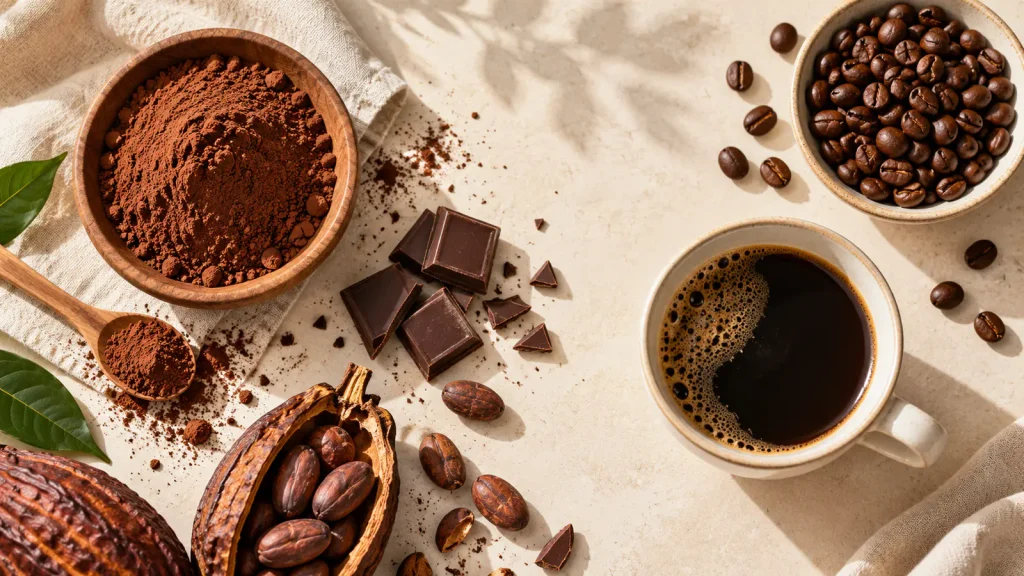
The comparison of theobromine vs caffeine starts with a family resemblance. Both belong to the same group of compounds, the methylxanthines, and they differ by a single methyl group. Caffeine is the one most people know from coffee, tea and energy drinks. Theobromine is the main methylxanthine in cocoa, and dark chocolate contains roughly ten times more of it than caffeine.
Close chemistry does not mean identical behaviour. The two compounds act on the same receptors with different strength, leave the body at different speeds and, in the few controlled human studies that exist, produced noticeably different results. This guide covers what the published research describes, where the numbers come from, and how to read a supplement label that lists theobromine, caffeine and guarana side by side.
Two methylxanthines from the same chemical family
Caffeine is 1,3,7-trimethylxanthine; theobromine is 3,7-dimethylxanthine. Remove one methyl group from caffeine and you have theobromine, which is more or less what the liver does. In a 1986 study of caffeine clearance in healthy volunteers, around 80% of caffeine was converted to paraxanthine, about 11% to theobromine and roughly 4% to theophylline. Anyone who drinks coffee therefore carries a little theobromine even without touching chocolate.
The dietary sources overlap less than the chemistry. Caffeine comes mainly from coffee, tea, guarana and drinks with added caffeine. Theobromine comes overwhelmingly from the cacao bean, so cocoa powder, dark chocolate and anything made from them. Tea and guarana are rich in caffeine and contain only small amounts of theobromine.
Theobromine vs caffeine at a glance
The figures below come from the pharmacology literature and from USDA food composition data. Study values describe groups of volunteers under controlled conditions, so individual responses can sit well outside them.
Fattore
caffeina
Teobromina
Chemical name
1,3,7-trimethylxanthine
3,7-dimethylxanthine
Main dietary sources
Coffee, tea, guarana, energy drinks
Cocoa powder, dark chocolate
Action at adenosine receptors
Blocks A1 and A2A receptors
Same receptors, roughly 2–3 times weaker binding
Solubility
Water-soluble
Poorly water-soluble
Time to peak blood level
About 30–40 minutes
About 2–3 hours
Half-life (Lelo et al., 1986)
4.1 hours
7.2 hours
Per 100 g dark chocolate, 70–85% cacao (USDA)
80 mg
802 mg
Per 100 g unsweetened cocoa powder (USDA)
230 mg
2,057 mg
Authorised EU health claims
None
None
Weaker at the receptor, slower to arrive
Both compounds work mainly by blocking adenosine receptors. Adenosine builds up during waking hours and signals the brain to wind down; occupying its receptors interrupts that signal. Both are also known to inhibit phosphodiesterase enzymes. A 2015 review in Frontiere della farmacologia covers both routes in detail.
The difference lies in strength and timing. Theobromine binds the A1 and A2A receptors with two to three times less affinity than caffeine. It is also far less soluble in water than caffeine, and it peaks in the blood after about two to three hours, against 30 to 40 minutes for caffeine.
Why theobromine stays in the body longer
The most cited head-to-head data come from a small pharmacokinetic study by Lelo and colleagues, published in the British Journal of Clinical Pharmacology in 1986. Six healthy men took caffeine and each of its three main metabolites on separate occasions. Theobromine’s half-life averaged 7.2 hours, against 4.1 hours for caffeine. Baggott and colleagues (2013) summarise wider ranges from the literature, about 2.5 to 5 hours for caffeine and 7 to 12 hours for theobromine, which reflects how much clearance varies from person to person.
In practice that means theobromine from an evening dessert is likely still circulating well after the caffeine in an after-dinner espresso has started to fall.
What controlled studies found
Human research on theobromine is thin, partly because it was long assumed to be behaviourally inert. Three placebo-controlled trials stand out. All are small, and all used fixed doses that say nothing about any particular product.
Baggott et al., 2013. Eighty healthy adults each took, on separate days, 250, 500 or 1,000 mg of theobromine, 200 mg of caffeine and a placebo. Caffeine produced the expected rise in reported alertness and changes in cardiovascular measures. Theobromine had limited subjective effects at 250 mg, was associated with negative mood effects at higher doses, and raised heart rate in a dose-dependent way. The full paper is open access on PubMed Central.
Mitchell et al., 2011. Twenty-four women took 700 mg of theobromine, 120 mg of caffeine, both together or a placebo. Caffeine raised alertness ratings and blood pressure; theobromine alone lowered blood pressure one hour after intake and reduced calmness ratings at three hours. The combination looked like caffeine on mood but showed no blood pressure effect. The authors tentatively suggested that theobromine may act more through peripheral than central changes.
Judelson et al., 2013. Twenty-four young men drank cocoa-based beverages containing 100, 200 or 400 mg of theobromine. None of those doses changed mood or vigilance, while 100 mg of caffeine reduced reported fatigue.
The results are mixed. The one cocoa-based trial found no effect at food-level doses, Baggott’s team concluded that theobromine at normal intakes may still contribute to the appeal of chocolate, and the highest doses tested produced unwanted effects. With between 24 and 80 participants each, none of them settles the question.
What the research does not support
It is common to read that theobromine gives a smoother or cleaner lift than caffeine. The trials above do not demonstrate that, and no health claim for theobromine appears in the EU Register of nutrition and health claims. Caffeine claims for alertness, physical performance and fat oxidation have all been assessed and are listed as non-authorised. Neither compound has an authorised EU health claim for mood, energy or concentration.
Safety guidance is far better developed for caffeine. The European Food Safety Authority’s 2015 opinion concluded that single doses of up to 200 mg, and up to 400 mg spread across a day, do not raise safety concerns for healthy adults, with a lower reference of 200 mg a day during pregnancy and breastfeeding. No equivalent intake reference exists for theobromine.
A note for dog owners
Theobromine is the main reason chocolate is dangerous for dogs. They clear it far more slowly than people, so amounts that are routine in a human diet can build up to harmful levels. Horses and some livestock are also sensitive, which is why EU feed rules set maximum theobromine levels in animal feed. Keep chocolate, cocoa and any product containing theobromine well out of reach of pets.
Reading a label that lists theobromine, caffeine and guarana
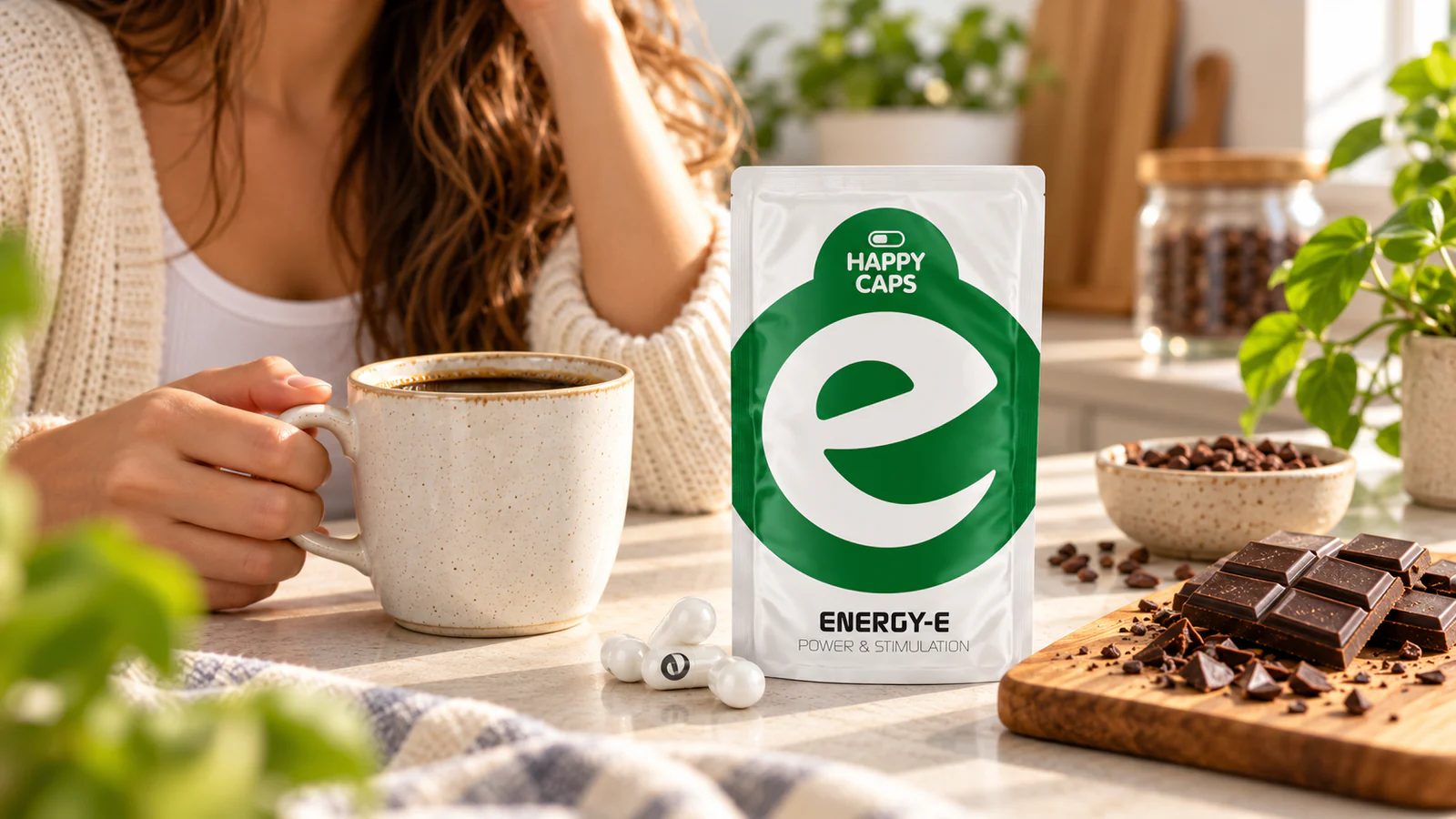
Several Happy Caps blends list more than one methylxanthine source. Party-E e Euphory-E both include theobromine alongside caffeine-containing ingredients, while Energy-E is built around guarana extract as its caffeine source. The table summarises what is listed, not what any product does.
Miscela
Methylxanthine sources listed
Other listed ingredients
Party-E
Theobromine, caffeine, green tea extract, yerba mate
Always check the label on your pack, which is the reference for the product you actually have. Three habits make a label like this easier to read:
Count every caffeine source. Guarana, green tea and yerba mate all contribute caffeine in addition to any caffeine listed on its own. The guide to guarana and its caffeine content compares it with coffee.
Add the rest of your day. Coffee, tea, cola, energy drinks and dark chocolate all add to the same total. The comparison of energy capsules, coffee and energy drinks puts those formats side by side.
Read the warnings, not just the ingredients. Products with added caffeine carry a caffeine statement under EU labelling rules. Happy Caps product pages state that the blends are for adults only and are not recommended during pregnancy or breastfeeding, or for people with heart conditions.
Theobromine and caffeine share a structure and a target, but differ in strength, speed and evidence. Caffeine acts faster, binds more strongly and has been studied far more. Theobromine arrives slowly, lingers longer and, in the limited research available, has not consistently shown the effects it is often credited with. Knowing which one is in a product, and where else it turns up in your day, is more useful than any promise attached to either.
If you would like to see which blends list these ingredients, the gamma di capsule Happy Caps shows each formula with its full ingredient list.


 100% ingrediente conforme






 Italiano
 English
 Nederlands
 Deutsch
 Français
 Español